Sennheiser Spectera Sits in at Eurovision Song Contest
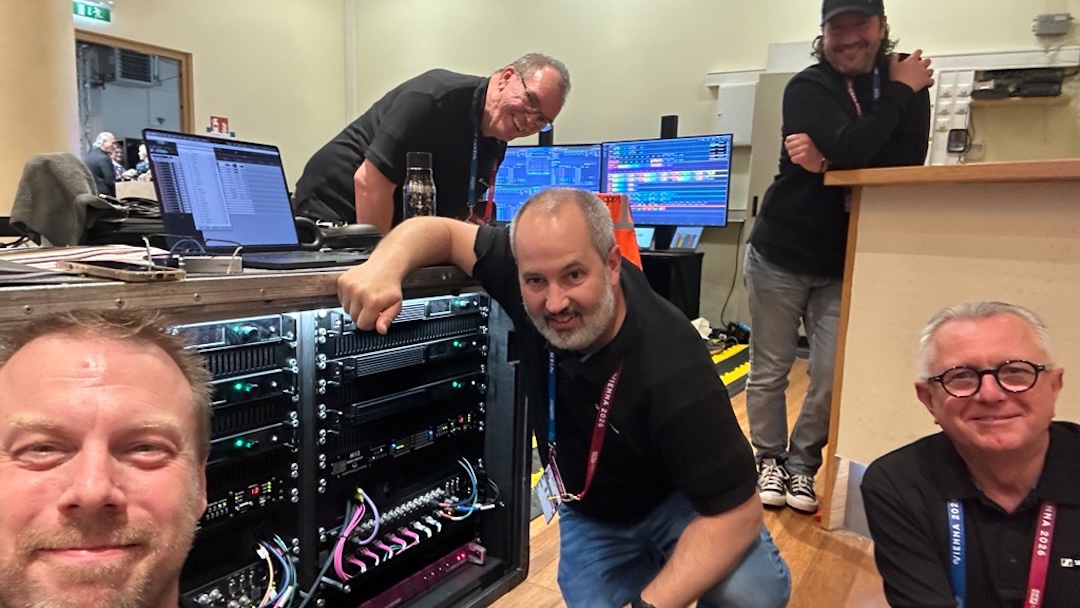
TAEs Jonas Næsby (front left), Vincent Tilgenkamp (middle), Gerhard Spyra (front right), Volker Schmitt (back left) and Neumann guest Patrick Greppi (back right) with the Spectera Base Stations. Wedemark/Vienna (May 29, 2026)—Sennheiser deployed its biggest Spectera set-up to date at Vienna’s Stadthalle for the recent Eurovision Song Contest (ESC) 2026. In a system created by technical production company Agorà, a total of four active Base Stations handled roughly 150 live streams for wireless mics, in-ear monitoring and control data.
Sennheiser’s technical application engineering (TAE) team, headed by Jonas Næsby and Volker Schmitt, were on site to provide support with the wideband system and associated new workflows. “The requirement of [host broadcaster] ORF was nicely simple and short: ‘We need coverage in the entire venue,’” recalled Schmitt. “We started out with two Spectera DAD antennas at stage right and green room left for each Base Station, and that gave us full transmit and receive power for the hall.
For extra reliability, we then added another two antennas per Base Station. Also, a firmware variant especially for the event had given us a preview of upcoming functionalities that were needed on site, such as a level recorder.” • Mix Music Production NYC 2026 Launches with Early Bird Tickets An RF control center in the sound room continuously provided a full overview of the current status of the Spectera wireless microphones and in-ears using Spectera WebUI and the Sonoros app.
The Stadthalle’s sound room, led by head of sound Gerhard Jansa, handled mic audio, IEM audio, artist audio preparation and audio distribution to the OB vans. Failsafe operation was key for the entire event; for example, the sound room accommodated two independent mixing desks with an operator each. Subscribe free to Mix magazine and our daily Smartbrief newsletter!
The same idea of reliability was behind the six Spectera Base Stations that were used. While four were active for audio and control data, working on one RF channel each, another one was exclusively dedicated to scanning the spectrum 24/7, but could also run as a spare as it was already linked with all antennas. A sixth Base Station was a true spare unit.
Discussion
Leave a comment — no account needed
No comments yet. Be the first to start the conversation!