Classic Tracks: The Tubes’ “White Punks On Dope”
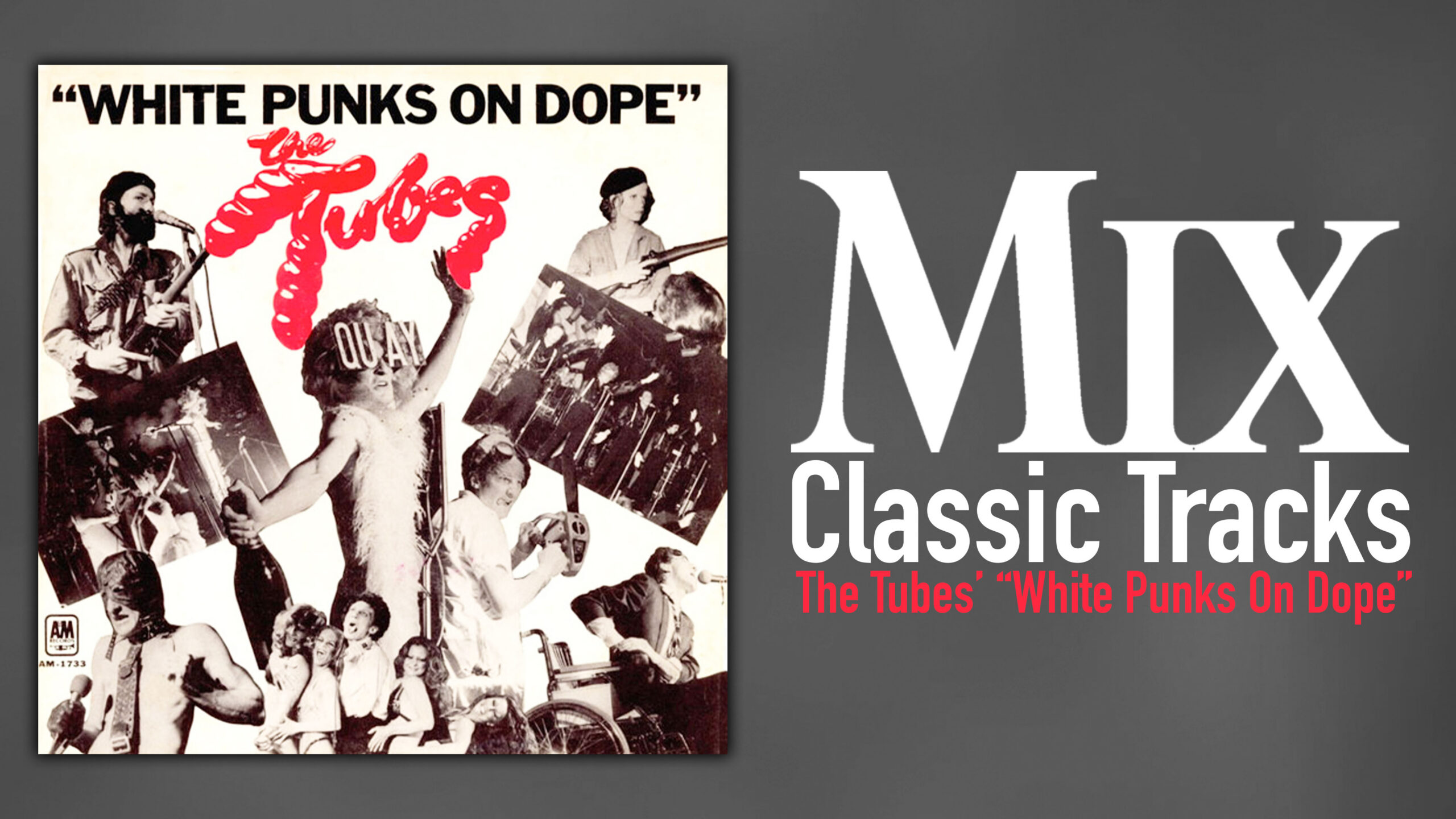
There are a few bands that have been fortunate to have created true rock and roll anthems. The Tubes are one of them. The first single from the group’s debut album, The Tubes, was the satirical and outlandish “White Punks On Dope,” released on A&M in June 1975.
<span data-mce-type="bookmark" style="display: inline-block; width: 0px; overflow: hidden; line-height: 0;" class="mce_SELRES_start"> </span> The band had emerged following the conjoining of two Phoenix-area bands, The Red White and Blues Band, featuring drummer Prairie Prince, guitarist Roger Steen, bassist David Killingsworth, and their roadie, a former hippie cowboy named John Waybill, known to his bandmates as Fee, short for “Fiji,” in recognition of his mane of curly hair. The other band, The Beans, had guitarist Bill Spooner, bassist Rick Anderson, keyboardist Vince Welnick and drummer Bob McIntosh. Prince moved his band, which had changed its name to“Arizon, to the Bay Area in 1969 so that he and his friend Michael Cotten could attend the San Francisco Art Institute.
Spooner’s band followed in summer 1970, moving in with their pals at a small two-bedroom condemned bungalow (dubbed “The Noriega Hilton”) at 48th Avenue and Noriega Street in the city’s Sunset District. Arizon spent four months playing at the Expo 70 World’s Fair in Japan, then upon their return fired Killingsworth and were without a bass player. After an unfruitful search, Spooner and the bands’ managers suggested merging the two groups into an “Arizona superband,” still performing as The Beans.
Waybill, who had begun covering for Killingsworth’s lead vocals, was brought to the front mic. “They said, ‘You sing so damn loud, why don’t you sing lead then?!” he recalls.
At Spooner’s urging, Cotten purchased one of the first ARP 2600 synthesizers, initially to add sound effects to film soundtracks at school. But soon he began playing with the band, sitting near the console at live shows, adding effects to various songs and processing Spooner’s guitars via a patch from the stage. The band quickly became known for its theatricality, creating characters and their own costumes.
“I suggested we let Fee sing a few songs—we could dress him up,” Spooner remembers. After a show in which Waybill dressed as Carmen Miranda, complete with fresh fruit on his head, belting out “Brazil,” Spooner recalls, “We went, ‘This is a thing! This might work!
’ So we kept it.” Fee Waybill (center) of The Tubes performs on stage in 1977 in Copenhagen, Denmark. After a show in which Waybill dressed as Carmen Miranda, complete with fresh fruit on his head, belting out ‘Brazil,’ guitarist Bill Spooner recalls, ‘We went, ‘This is a thing!
This might work!’ So we kept it.’ (PHOTO: Jorgen Angel/Redferns) One night in late 1972, Spooner and Evans were attending a party at Prince’s apartment when Evans told the guitarist about an article he had read about recording artists coming to San Francisco and recording with The Jefferson Airplane or The Dead.
“He said, ‘They smoked a lot a pot and had ashtrays full of cocaine. And it was just a bunch of white punks on dope,’” Spooner recalls. “Then he said, ‘That’s a great song title, don’t you think?
Let’s sit down and write some lyrics for it.’ The apartment was so packed, the only place we could find was underneath Prairie’s kitchen table.” The next morning, they presented their unusual lyrics to the band, in the back bedroom at the Noriega Hilton, where their manager had his office.
“We woke up and Bill was all excited—they had stayed up too late and come up with this idea, but they didn’t have any music,” Steen remembers. “It had a shocking title, so we all went, ‘Oh… what?’” Steen had what would become the chorus melody as a riff, “kind of a blues tune, ‘Don’t let my paycheck down,’” he sings to the tune of “We’re white punks on dope.
” The band rehearsed the song, as they typically did, in the basement of the house, and began playing it not long after, the song finding its long, jammy extension as time went on. “We’re in a band house, playing all day every day,” Steen says. “We had tons of parts trying to find a place for.
” The “We’re white punks…” answer phrase soon became an anthemic chant from fans at shows. The character delivering the song was one called “Rod Planet,” a cross between Rod Stewart and Robert Plant. “I wanted to do the quintessential cross-dressing rock star drug addict,” Waybill explains.
“So I had this big wig, effeminate clothing and big shoes.” Rod evolved further on September 5, 1973, the first night of a three-night stand at The Matrix opening up for The New York Dolls. The Dolls showed up for soundcheck in full regalia—hair, makeup, women’s clothing, and BIG platform shoes.
“I thought, ‘God, this is so pretentious,’” he says, “Well, I’ve gotta take the piss out of them.” So Waybill went out and got four giant tomato juice cans, emptied the juice, and taped the cans to his boots with gaffer tape, covered it all with glue and sparkles. You know, 10-inch platform shoes!
One of the Dolls, he thinks, also slipped him a Quaalude before he went on. “I was completely whacked!” Rod Planet thus became Quay Lewd, Waybill eventually adding other pieces to his spandex costume—including an 8-inch rubber dildo, hanging out from his crotch.
The Tubes’ live shows sometimes turned into performance art. The band, by the way, had, a few months before, been forced to find a new name. “We were in that same back room, and somebody brought in an album by some group from the Northeast, called Beans,” released the previous year, says Steen.
Adds Prince, “It had a cartoon on the front cover of a guy eating beans, until they were coming out his ears.” So the fellas went through the laborious process of trying to find a name, writing on a blackboard names like “The Radarmen From Uranus” and “The Comic Ozzies,” among others. Cotten had suggested “Tubes, Rods and Bulbs” (based on parts of the eye), which was thrown into a hat, along with 100 others.
Cotten’s apparently had been treated with mayonnaise – a favorite of house dog The Husky Baby Sandwich, who then pulled it out of the hat. The Tubes it was. Recording ‘Punks’ The Tubes had been sending out demos for a couple of years, typically with the same results.
“They’d send them back,” says Spooner, “and if they’d had emojis back then, it would be a guy scratching his head: ‘What the fuck is this? Are they a show band? A punk band?
’” A video demo, made with the help of choreographer Kenny Ortega, was made, drawing the attention of A & M Records A & R man Kip Cohen, who scouted the band at a gig in San Francisco. Not long after inviting Prince and Cotten to come paint the outside wall of A & M’s large studio building with flying records in Fall 1974, they were signed to the label. “I think it was a case of, “Okay, you take ‘em, because you need a weirdo band,” Spooner notes.
Producer Al Kooper had wrapped up work on the latest Lynyrd Skynyrd album, Nuthin’ Fancy, in early 1975, and, looking for his next project, queried a friend, Dorene Lauer, who worked with Cohen at A & M, to see if there were any acts in need of a producer. Kooper had actually heard one of The Tubes’ demos a few years earlier and loved it. Kooper flew to San Francisco to see meet with the band at a rehearsal stage at S.
I.R., where they played him a selection of songs from their stage act.
“I knew nothing about what that was like,” he says. “I based it solely on their music, which I just thought was incredibly original. People were going to have to hear this and want to go see them, without knowing what they were going to see.
And when I watched them rehearse, I was floored.” The producer selected eight songs—including “White Punks on Dope.” Kooper returned to L.
A., the band coming down in early March 1975. They then began additional rehearsals and rundowns with Kooper at The Record Plant, where the album was to be recorded, practicing in the studio’s then-unfinished Studio C.
The first thing Kooper addressed was getting the band members to learn their parts. “We would play him a song, and he would say, ‘Okay now just the drums and bass play the song,’ and we couldn’t do that,” Spooner recalls. “It was the first time we had realized everyone had to individually learn their part—and play it the same way, take after take.
So that’s what I learned from Al Kooper.” Kooper had been a regular visitor to both Record Plants, and he had been to the Los Angeles studio ever since attending opening day in 1969. To engineer this project, he turned to studio veteran Lee Kiefer, who started there in 1970, earning $40/week as a janitor, eventually creating a training program for new engineers.
Early in 1975, Kooper was visiting the studio’s Sausalito facility, where Kiefer was at work on another project, and asked for Kiefer’s help with something. “He had come from Atlanta, where he had recorded Lynyrd Skynyrd’s Nuthin’ Fancy album, that he had engineered,” the engineer recalls. “It sounded as big around as a peanut—it sounded absolutely terrible.
” While there, Kooper also played Kiefer The Tubes’ demo, and he was immediately smitten. “I was really excited about The Tubes. I definitely wanted to do that album.
And Al said, ‘Well, here, if you can fix this [the Skynyrd album], you can do The Tubes.” Kiefer did both. “Lee was incredibly competent,” says Kooper.
“He was able to do anything I wanted.” The sessions began Monday March 17, 1975, with Don Wood assisting, recording into the middle of the following week, March 26, tracking four songs: “Mondo Bondage,” “Space Baby,” “What Do You Want From Life,” and the album opener, “Up From the Deep.” There was an 11-day break, before they returned to work, during which Kooper finally got to see the band perform live, at a surprise showing at The Palomino Club in North Hollywood.
Discussion
Leave a comment — no account needed
No comments yet. Be the first to start the conversation!